Regenesis Protocol Validation Report IACS
A validation study of how psychological affect shifts across two Regenesis Recovery Pod protocols — Launch and Land — in a 20-participant cohort, triangulating standardised pre/post self-report, postsession verbal transcripts, and voice-acoustic analysis.

Dr. Nicco Reggente
IACS

Smmm E C T I O N 1 · D E S C R I P T I V E S
The Cohort
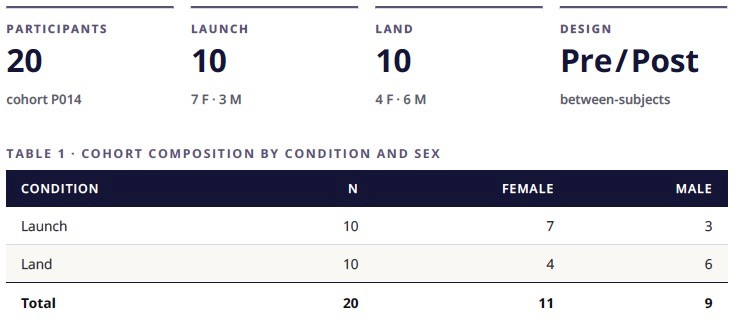
Twenty participants each completed a single Regenesis Recovery Pod session — ten in the Launch
protocol, ten in Land. Psychological affect was measured immediately before and after each
session with two standardised instruments, and a post-session verbal account was recorded.
Participants were blind to condition — the pod's interior screen was blank and each session
was triggered from outside, so no one could infer whether they received Launch or Land
before, during, or while giving their responses. The headline is consistent across channels:
both protocols reduced tension, fatigue, and anxiety; they diverge, as designed, on vigour —
which Launch preserved and Land released.
S E C T I O N 2 · P S Y C H O L O G I C A L S E L F - R E P O R T
Affect Before and After
We assessed affect on three levels: the six POMS mood subscales, two summary indices
(Total Mood Disturbance and STAI state anxiety), and the thirty individual POMS items. Pre
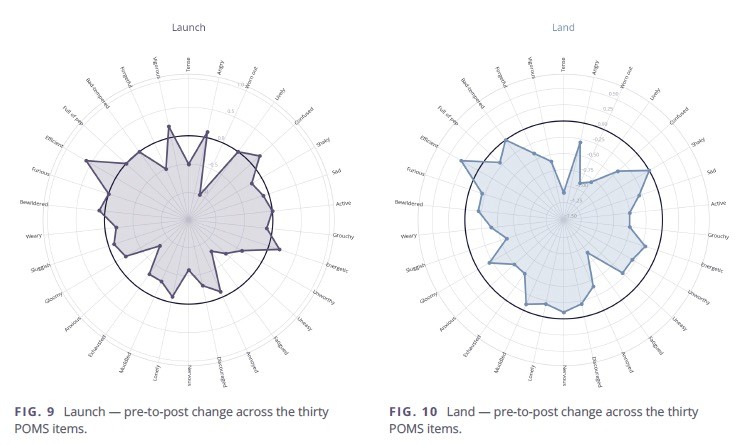
and Post values are shown as one bar chart per condition; the pre-to-post change is shown
as a per-condition radar. The statistics — paired t-tests within each condition and Welch's ttest
between conditions — are reported in the tables, with significant rows set in bold.
POMS Subscales: Before and After
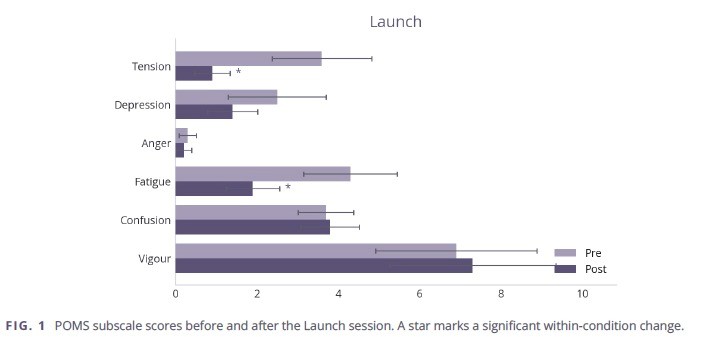
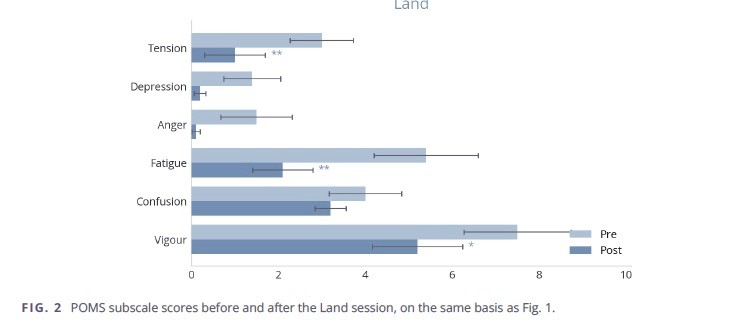
Figures 1 and 2 give each arm's mood profile before and after the session. Both groups began from a
broadly similar profile — moderate tension, fatigue, and confusion, with healthy vigour — and both left
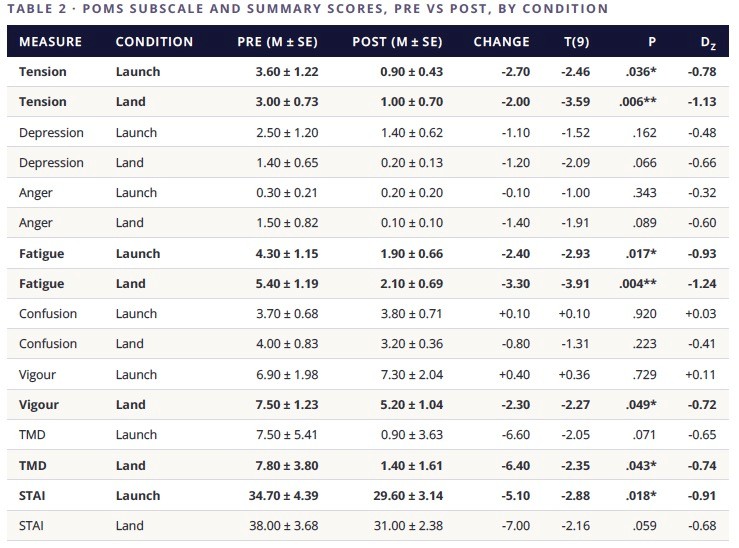
lower on the negative subscales. Table 2 reports the paired comparison for every measure.
POMS Subscales: The Change
The change radars isolate what each session did. Tension and Fatigue fell significantly under both
protocols; Depression and Anger trended down without reaching significance at this sample size. The
protocols separate on Vigour: it held steady under Launch (Δ +0.4, p = 0.73) and fell under Land (Δ -2.3,
p = 0.05) — the signature contrast the protocols are designed to produce: Launch leaves the participant
calm but energised and ready, while Land lets energy settle into deeper rest.
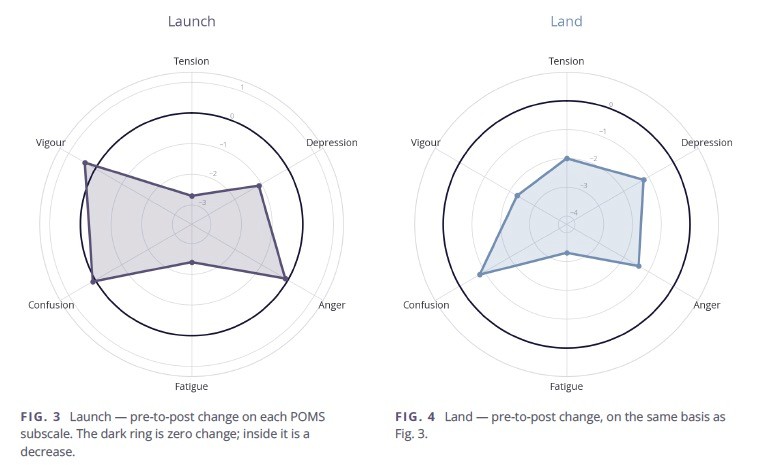
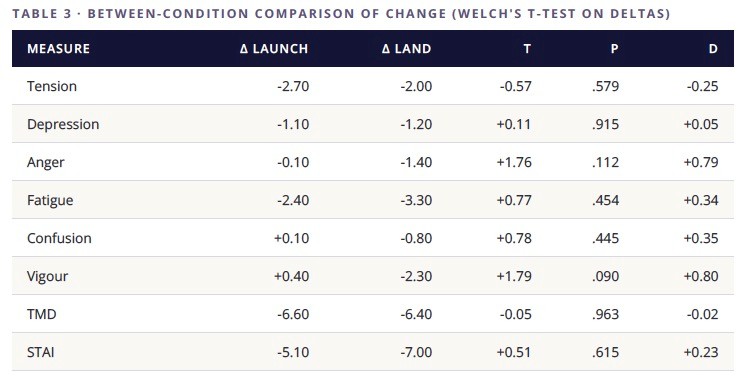
The between-condition test asks whether one protocol moved a subscale more than the other. No subscale
change differs significantly between conditions at this sample size; the Vigour delta is the widest gap —
Launch +0.4 versus Land -2.3, a large effect (d = 0.80) that falls just short of significance (p = 0.09).
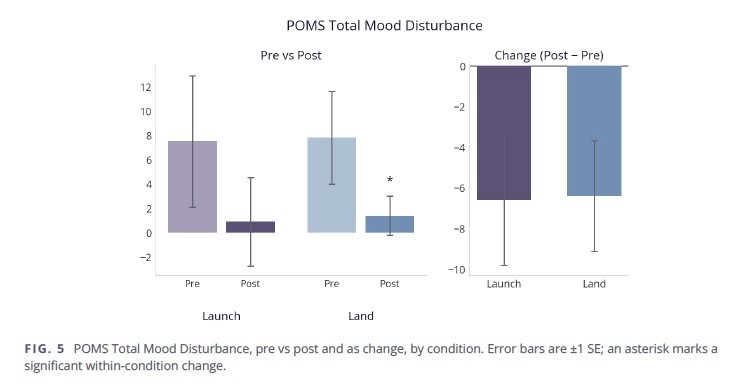
Total Mood Disturbance & State Anxiety
Total Mood Disturbance (TMD) — the POMS summary index — and STAI state anxiety both fell substantially
under both protocols: overall mood disturbance and anxiety came down whether participants launched or
landed. TMD dropped by roughly two-thirds of its starting value in each arm; STAI state anxiety fell by
about 5–7 points.
POMS Items: Before and After
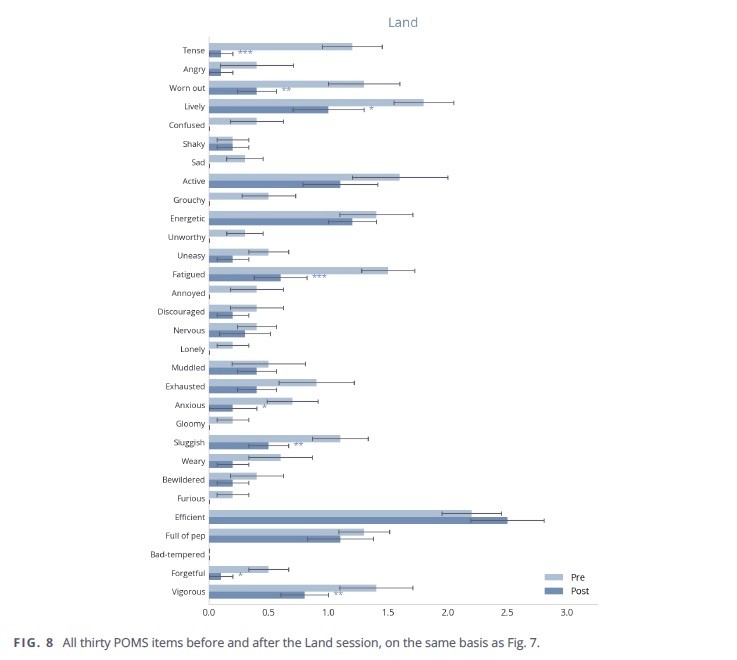
Resolved to all thirty individual POMS items, the figures below give the full item-level profile before and
after each session — the fine-grained companion to the subscale view.
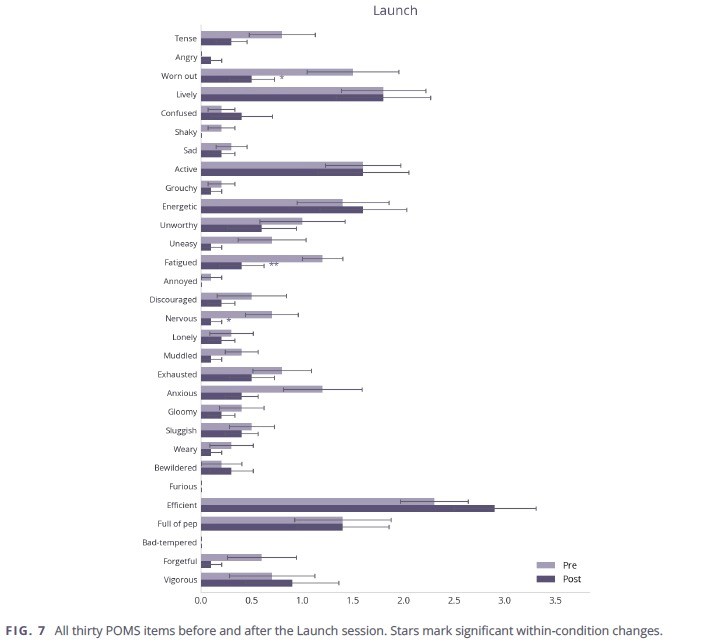
POMS Items: The Change
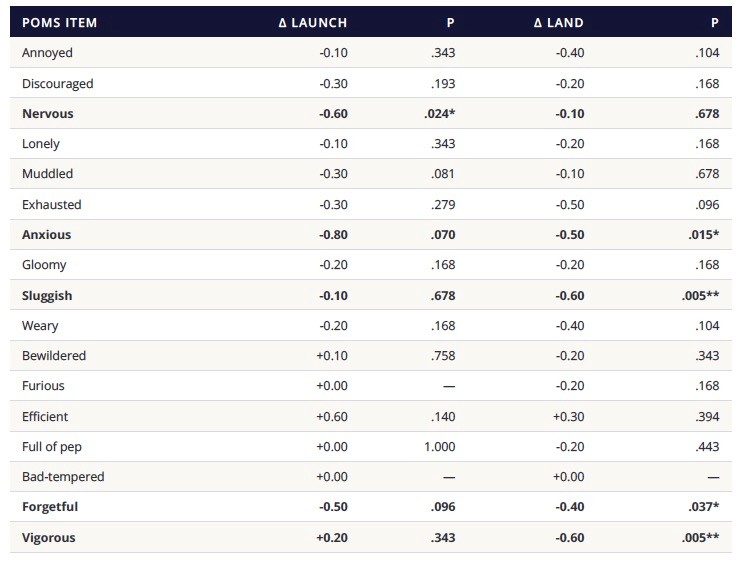
3 items changed significantly under Launch and 8 under Land. The item that most distinguishes the
protocols is Vigorous: it edged up under Launch (+0.2) and fell under Land (-0.6), a difference that is
significant between conditions (p = 0.006) — the item-level echo of the subscale Vigour story. Table 4 gives
the change and its test for every item.

S E C T I O N 3 · T R A N S C R I P T A N A L Y S I S
What Participants Said
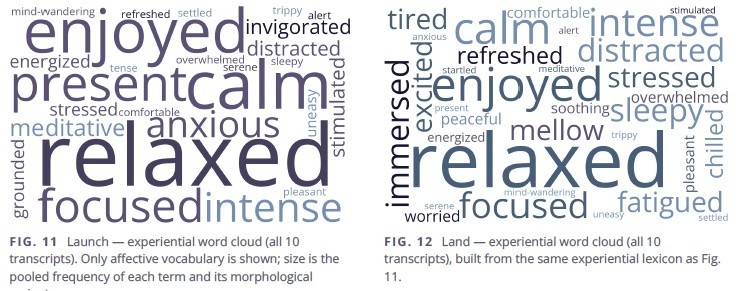
After each session participants gave an unstructured verbal account of the experience.
Below, each condition's transcripts are summarised twice — first as an experiential word
cloud of the affective vocabulary participants reached for, then as a synthesis of the themes
shared across participants within that condition.
Launch — Thematic Synthesis
Synthesised from the post-session verbal feedback of all 10 Launch participants. Launch is intended to settle
nerves while keeping the person vigilant and ready for an upcoming event.
How the experience made people feel
Participants left Launch calm and at ease — but, distinctively, not sedated. The recurring report is a relaxed
alertness. Several described feeling "relaxed but energized," "ready to take on the day," or "invigorated...
stabilized, but not in an overly calm or sedating way." One participant noted the experience "kept me from
falling asleep" even as it relaxed them; another described oscillating between "high alertness and
relaxation" as the music and lights shifted. Participants who arrived stressed, tense, or "burnt out" after a
hard week consistently reported reaching a calmer, clearer state. This calm-but-ready quality maps closely
onto Launch's intent, and is consistent with the self-report data, where Vigour held steady (Δ +0.4) rather
than falling.
What parts of the experience drove it
Three elements recur as the active ingredients:
The opening breathing exercise — near-universally praised as an easy, low-pressure on-ramp ("loved
the breath work," "the deep breaths put me into a really relaxed state"), valued even by participants
with no meditation background.
The eyes-closed light segment — the clear centrepiece. Participants reported their deepest calm here,
often with vivid closed-eye imagery (nature scenes, positive childhood memories) and a strong sense of
presence.
The music — for Launch specifically, the upbeat music supplied the energizing half of the effect ("made
me want to dance," "captivating," "made me want to groove").
Seat and bass vibration and the scent were consistent supporting contributors.
Constructive criticism
Brightness and intensity. Open-eye visuals and parts of the light sequence were repeatedly called "too
bright" or "intense," and occasionally provoked momentary anxiety. Intensity controls that participants
can actually feel taking effect would help.
The breathing segment's soundtrack was, for some, too stimulating; a calmer, more grounding bed
under the opening breath work was requested.
Thermal comfort. Heat and poor airflow inside the pod were noted, compounded when the door
stayed open.
Audio. A vocal track in an unrecognised language repeatedly "stuck out" and pulled attention.
Comfort. The head and neck angle lacked support.
The closing screen-viewing segment underwhelmed — described as the weakest part, with ambient
bird sound that "didn't match."
For Launch's specific goal — vigilant readiness — the energizing music and the alerting light segment work
as intended. The main risk to that state is over-bright or over-intense stimuli tipping calm into momentary
anxiety; tighter control of peak brightness is the highest-value refinement.
Land — Thematic Synthesis
Synthesised from the post-session verbal feedback of all 10 Land participants. Land is intended to bring nerves
down and ease the person into deeper relaxation after an intense event.
How the experience made people feel
Land produced a deeper, heavier calm. Participants described feeling "chilled out," "mellow," "at peace,"
"reset," "refreshed," "settled," and "sanguine" — and, tellingly, drowsy: one fell asleep and "took a nice little
nap," while others reported time passing quickly through immersion. The dominant note is winding down
— a release of the day's stress, reduced fatigue and "worn out" feeling, and a quiet space "to think" and
"get more organized." A minority diverged (one felt slightly "on edge," one left re-energized), but the central
experience was a descent into deeper relaxation. The self-report data echo this: Fatigue fell furthest in
Land, and Vigour dropped significantly (Δ −2.3) — a winding-down signature absent in Launch.
What parts of the experience drove it
The core drivers mirror Launch — the opening breathing exercise and the eyes-closed light segment
were the most-cited, the closed-eye lights again producing immersive imagery (one participant moved
through a forest, underwater, and clouds as the colours changed). Two contributors were comparatively
more prominent for Land:
The haptic/vibration bed — a "favourite" for several, "a nice little area to meditate."
Spatial audio and scent — credited by several as the single biggest immersive factor.
The eyes-closed segment also doubled as a space for cognitive offloading: participants "sorted thoughts"
and "worked through the conflicts and worries" of the day.
Constructive criticism
Haptic intensity is the key tension for Land. The vibration some loved was, for others, "super, super
intense" and "kind of stressful" — working against the wind-down goal. A gentler default haptic level for
this protocol is the highest-value change.
Light pulsation was, for some, too long and too constant; participants wanted darker intervals and an
ebb-and-flow rather than continuous strobing.
Enclosure. With the door open, peripheral distractions repeatedly broke immersion; multiple
participants wanted the door closed or a curtain. For a relaxation protocol this matters more than for
Launch.
The guiding voice was sometimes abrupt or startling, and at other times mixed too quietly to follow.
Thermal comfort. Stuffiness was noted, with a request for ventilation.
Open-eye visual segments (pre and post) underwhelmed — "like a screensaver," pixelated, choppy.
For Land's goal — deeper relaxation — the breathing, scent, and immersive audio land well. The main risks
are over-intense haptics and over-constant light keeping the nervous system activated when the aim is to
let it settle.
S E C T I O N 4 · V O C A L A N A L Y S I S
How the Voice Sounded
Section 3 looked at what participants said; this section looks at how they said it. Each postsession
recording was passed through a voice-only acoustic engine that isolates the
participant's speech and extracts pitch, voice quality, energy, prosody, and a model estimate
of dimensional affect — arousal, valence, and dominance — from the sound of the voice
alone, independent of the words. Recordings were taken once, after the session, so this
channel is a between-condition comparison with no baseline.
D A T A Q U A L I T Y
13 of the 20 recordings were flagged low signal-to-noise — they were captured immediately on
exiting the pod, not in a studio. Acoustic features are noisier on those recordings, so the vocal
channel is best read as corroborating evidence alongside the self-report and transcripts, rather than
as a standalone result.
Dimensional Affect
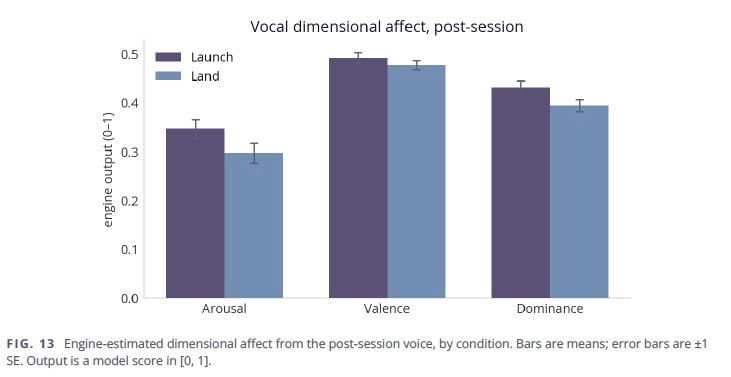
The clearest vocal result is a between-condition gap in arousal and dominance. Launch voices carried
higher arousal (Launch 0.35 vs Land 0.30; d = 0.80, p = 0.092) and higher dominance (Launch 0.43 vs Land
0.39; d = 0.92, p = 0.054); valence was similar across conditions. These are large effects that fall short of
significance at ten participants per arm — but their direction is the point: the voice independently echoes
the self-report. Where the POMS Vigour subscale held under Launch and fell under Land, the vocal
channel shows the same split — Launch participants left sounding more activated and more in command,
Land participants more settled.
Acoustic and Prosodic Detail
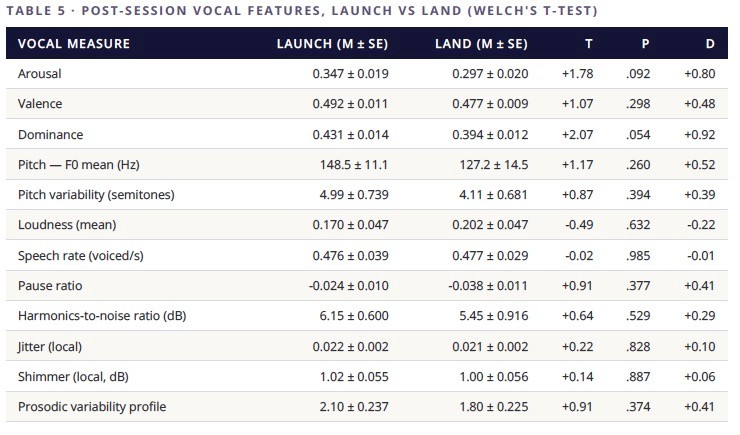
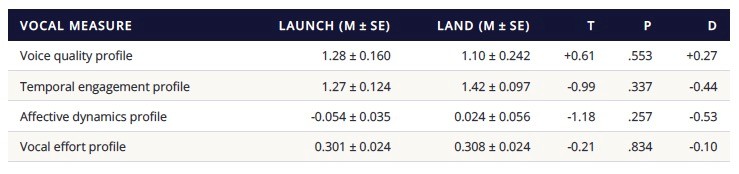
Beneath the affect estimate, the raw acoustic features tell a consistent if quieter story. Launch voices sat at
a higher pitch and carried more pitch movement — both classic correlates of activation — while voicequality
and timing measures, and the engine's five cross-feature signatures, did not separate the
conditions. No vocal feature reached significance at this sample size; the table below gives the full
comparison.
Candidate Phenomenological Signals
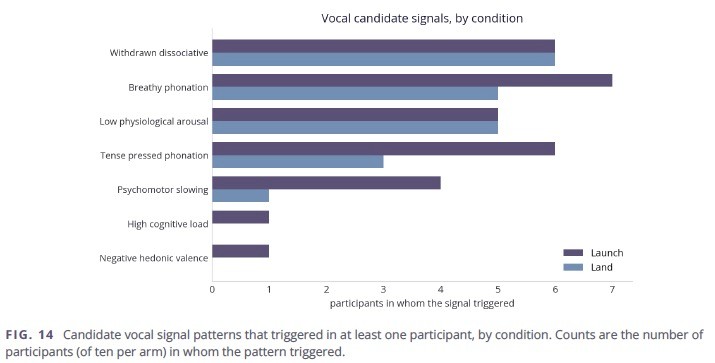
The engine also flags candidate signal patterns — named acoustic configurations the speech-science
literature loosely associates with experiential states. It emits these as evidence patterns, never as labels,
each with its own non-specificity caveat. Both conditions triggered a low-arousal pattern in about half of
participants — consistent with a calming effect across the board — and Launch recordings triggered the
tense / pressed-phonation pattern somewhat more often than Land. These pattern counts are exploratory,
rest on low-SNR audio, and several point in directions the dimensional-affect result does not; they should
be read as leads, not findings.
S E C T I O N 5 · S Y N T H E S I S
Final Summary
Three independent channels — standardised self-report, the content of what participants
said, and the sound of how they said it — converge on one picture. Both Regenesis Recovery Pod
protocols are effective calming interventions, and they diverge, as designed, on a single
dimension: activation.
What the Three Channels Agree On
Every channel shows the same two-part result. First, both protocols calm. Self-report: tension, fatigue, and
anxiety fell under both Launch and Land, and Total Mood Disturbance dropped by roughly two-thirds in
each arm. Transcripts: participants in both conditions described leaving relaxed, calmer, and lighter. Voice:
arousal was low-to-moderate in both arms. Second, the protocols separate on energy. Self-report Vigour
held steady under Launch but fell under Land. Transcripts: Launch participants described feeling "relaxed
but energised" and "ready," Land participants described winding down, growing drowsy, and settling into
deeper rest. Voice: Launch participants sounded more aroused and more dominant than Land participants.
A finding in one channel is a hypothesis; a finding in all three, in the same direction, is the validated result
of this study: Launch and Land produce measurably different affective end-states, each in its intended
direction — Launch calm but ready, Land calm and wound down. And because participants were blind to
condition throughout — the pod screen blank, each session triggered from outside — that contrast cannot
be an artefact of expectancy: no participant knew which protocol they were responding to.
Making Each Protocol Deliver Its Intent
Launch — intended to calm nerves while keeping the person vigilant and ready — is doing both. The
energising music and the eyes-closed light segment supply the "ready" half and should be preserved. The
main risk to the "calm" half is over-bright, over-intense stimuli: participants reported moments where peak
brightness tipped calm into momentary anxiety. Tightening the ceiling on brightness and light intensity is
the highest-value refinement, and the weak closing screen segment is the clearest place to redesign.
Land — intended to bring nerves down into deeper relaxation after an intense event — is also doing its job:
it produced the largest fatigue drop, released vigour, and left the most settled voices. Its main friction is
intensity working against the goal — the haptic vibration that some participants loved was, for others,
"super intense" and even "stressful," and the light pulsation ran too long and too constant. A gentler
default haptic level and an ebbing light sequence, with darker intervals, would let the nervous system settle
rather than stay activated. Several Land participants were also pulled out of immersion by peripheral
distraction when the pod door was open; for a wind-down protocol, enclosure matters.
Two refinements apply to both protocols. The opening breathing exercise was the single most-praised
element across every transcript — an easy, effective on-ramp that should be kept and, several participants
suggested, given a little more time. And thermal comfort — heat and stuffiness inside the pod — was
raised often enough in both arms to be worth addressing directly.
B O T T O M L I N E
The validation question is answered: in this cohort, the two Regenesis Recovery Pod protocols deliver distinct,
intended affective shifts, and the contrast is visible in mood scores, in participants' own words, and
in their voices. Tighter control of peak intensity for Launch, and a gentler, ebbing profile for Land,
would sharpen each protocol's delivery of the state it is designed to produce.
Continue exploring


Be first to book a session near you
20-Minute Sessions
8 Modalities
Instant Relaxation
Immersive Recovery
20-minute Regenesis sessions. We’ll email you when a Pod opens in your area.